The voice behind the sword
Shigin: the chanted poetry behind kenbu
Every kenbu piece is set to a poem chanted aloud. Here is what shigin is, who wrote the verses and what to listen for before the sword moves.
Book the kenbu show ↗What shigin is
Shigin is a Japanese art of chanting poetry: the poem is called shi, the chanting gin. It can be performed by one person or by a group, loudly in public, softly among friends or in private. Both Japanese poems and Chinese ones are used, and the Chinese works are read aloud in Japanese. In kenbu, shigin is not background music. It is the other half of the performance, and the dancer's movements follow it line by line.
Where it came from
Shigin is thought to have begun in China in the early first millennium AD, and it may have reached Japan around the fifth century. Poems were probably first chanted in Chinese and later given Japanese readings. New gin have been written since, but the standard layout has stayed the same, so a chant today is built much as one was centuries ago. That long continuity is part of what a kenbu show borrows when it sets a sword dance to a verse chanted aloud.
Where the verses come from
Most kenbu poems are classical Chinese poems called kanshi, usually short. The commonest form has four lines of seven characters each, called shichigon-zekku, and a five-character version exists too. Japanese forms such as waka and haiku appear as well. The Samurai Kenbu Theater says many of the poems used in kenbu were written by samurai, so many verses deal with battle, duty and the sword. Understanding a poem's author, its content and its historical background is recommended for appreciating the choreography, which is why the theatre suggests asking for the programme in advance.
How it is chanted
Practitioners often train on tatami mats, kneeling, and they project the voice from the belly, not the chest. Written gin carry notes for tone, breath points and word order. A typical gin lasts about a minute and a half and takes four breaths, and the reciter usually stands and performs from memory. A koto or shakuhachi may accompany the voice. In kenbu, the reciter stands at the side of the stage while the dancer works in the centre, and today's mainstream style adds music on top. Bells and a gong are among the other instruments used.
Reciter and dancer
Kenbu uses two Japanese terms for the pair: the ginshi recites, and the maishi dances. The order matters. The dancer gives a shout as a signal, and the reciter begins. From there, the sword and fan interpret what the voice is saying. A performance can be very short, as little as two and a half minutes, and a typical programme is about three to five minutes. That means each piece is a compact story, with the poem as its script, and a show strings several of them together.
Two poems worth knowing
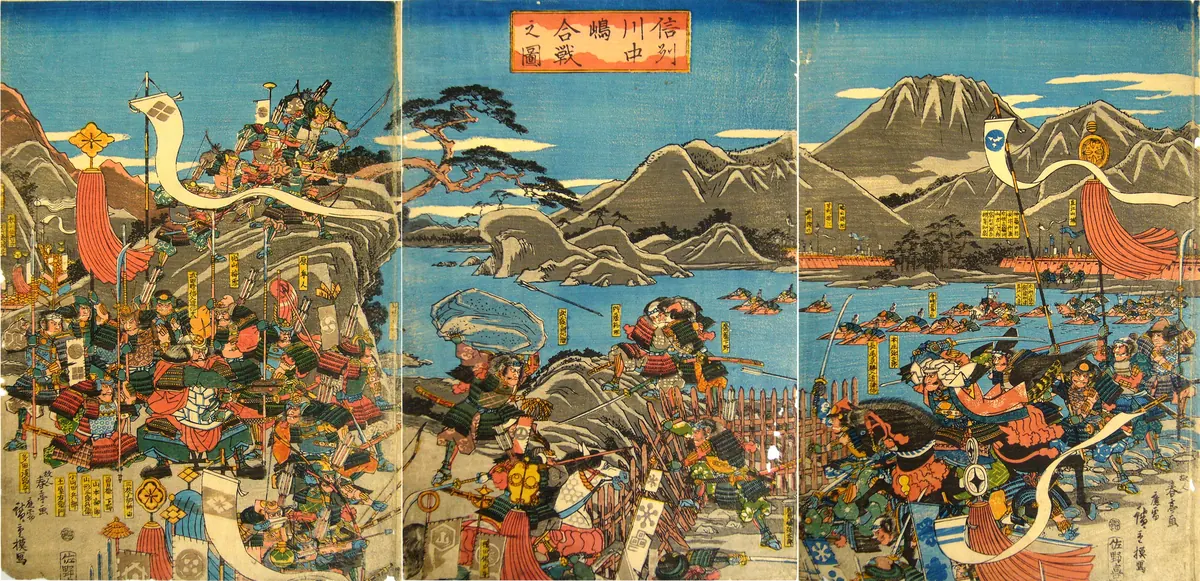
The theatre's essays describe two. Rai San'yō's verse on the warlords Uesugi Kenshin and Takeda Shingen, popularly called Kawanakajima, is told from Uesugi's side. Rai lived from 1780 to 1832 and died in Kyoto. The other is Tsurugitachi, a piece built on a poem by Ōtomo no Yakamochi, who lived from 718 to 785 and appears in the Manyōshū, Japan's oldest surviving poetry collection. He wrote it as a lesson for his descendants on how to behave so the family name would not be tarnished.
What to listen for
You will not follow the words in Japanese, but you can follow the shape. The voice rises and falls in set patterns, with breaths marking the end of a line. The English narration gives the history behind each demonstration, and the poem's story gives the movement its meaning. Listen for how the voice and the sword move together, because that pairing is the whole idea.
A minority art
Shigin is described as a minority art, kept up mostly by older practitioners, and kenbu is one of the places where it is still seen on stage. That is part of why it is worth hearing live. The Kyoto theatre was founded in 2014 and describes its aim as increasing the presence of kenbu. If the sound of chanted poetry is new to you, treat it like unfamiliar music: let it wash over you first, and the sword work will make more sense afterwards. If you would like the story before you go, the guide to the art form tells the Kawanakajima story in more detail.
Sources